Most entrepreneurs think of an IPO as the end of the journey—the moment when “we made it.” The reality of capital markets teaches something entirely different: companies that enter the public market to raise hype are typically those that disappoint. Companies that enter to raise capital and build a business—those are the ones that create value. The story of Beyond Oil is one of the clearest illustrations of this difference.
In 2012, Yehonatan Or and his father Michael Pinchas Or identified a problem every chef and restaurant owner knows: frying oil used repeatedly accumulates harmful substances, and no one really talks about it. This was not a classic “startup” idea. This was an obsession. For over a decade, father and son researched, failed, and tried again. The solution that emerged was elegant in its simplicity: a functional powder added to frying oil that neutralizes harmful substances and significantly extends the oil’s life—without compromising taste, food safety, or operational profitability. Simple to explain. Very difficult to develop.
Only around 2021, after nearly a decade of development, came the first proof of feasibility from external parties—an initial indication that the technology works under real market conditions. This was the moment when the company turned its attention to the capital markets—not as a destination, but as a working tool.
RTO—A Strategically Timed Move
In May 2022, Beyond Oil completed a Reverse Takeover (RTO) transaction—a mechanism whereby a private company becomes public through a merger with an existing public shell—and was listed for trading on the CSE, the Canadian secondary exchange designed for early-stage companies. Entry price: approximately $0.50 USD (approximately $0.75 CAD) per share, at a market capitalization of approximately $27 million. The company had a product and initial testimonials—but still no real revenue engine. And that is precisely the point.
The first years after entering the stock exchange were not dramatic. The stock traded below the IPO price, trading volumes were low, and the market did not react with enthusiasm. This was exactly what should happen when an early-stage company enters the market before proving itself commercially. But behind the scenes, the capital raised was doing its job: building a distribution network, entering new markets, and acquiring initial customers. The focus was not on the stock price—but on establishing the business model.
The Turning Point
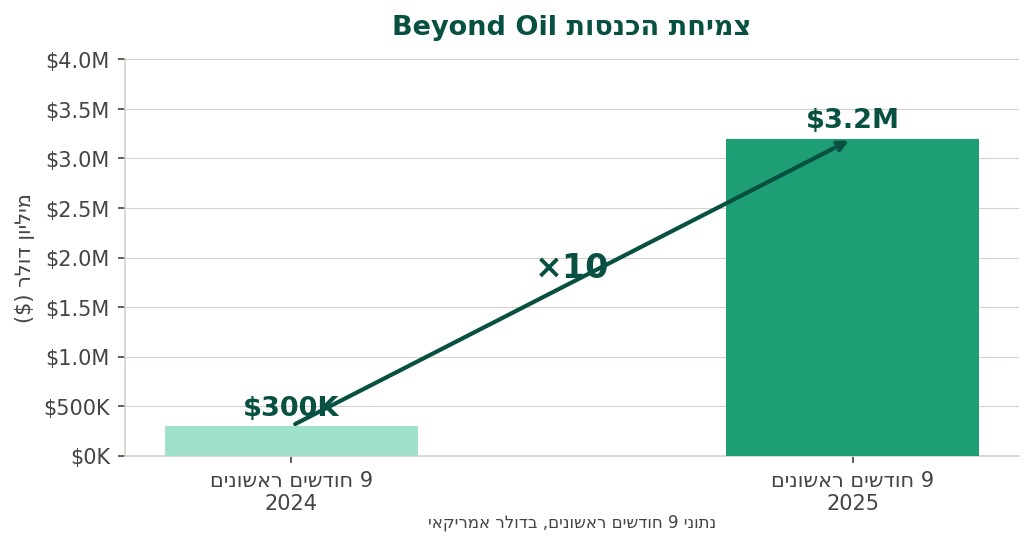
After approximately two years of quiet building, the numbers began to speak. The company’s revenues grew from approximately $300,000 in the first nine months of 2024 to approximately $3.2 million in the same period in 2025—a tenfold increase in one year. Alongside this, the company began to show positive and significant gross profit, an indication that the business model holds at the operational level as well.
Another critical characteristic: the product is a consumable sold to businesses—meaning a customer who joins continues to purchase. Not a one-time transaction, but recurring revenue, which is the holy grail of any stable business model.
No less significant was the entry of Clal Insurance as a lead investor—out of total fundraising of over $15 million, approximately $8 million came from this institutional investment. In the investment world, the entry of an institutional entity into an early-stage company is not just an injection of capital—it is a market signal. It tells other players: we have examined this, it is serious.
The Move to TSX—A Shift in Market Perception
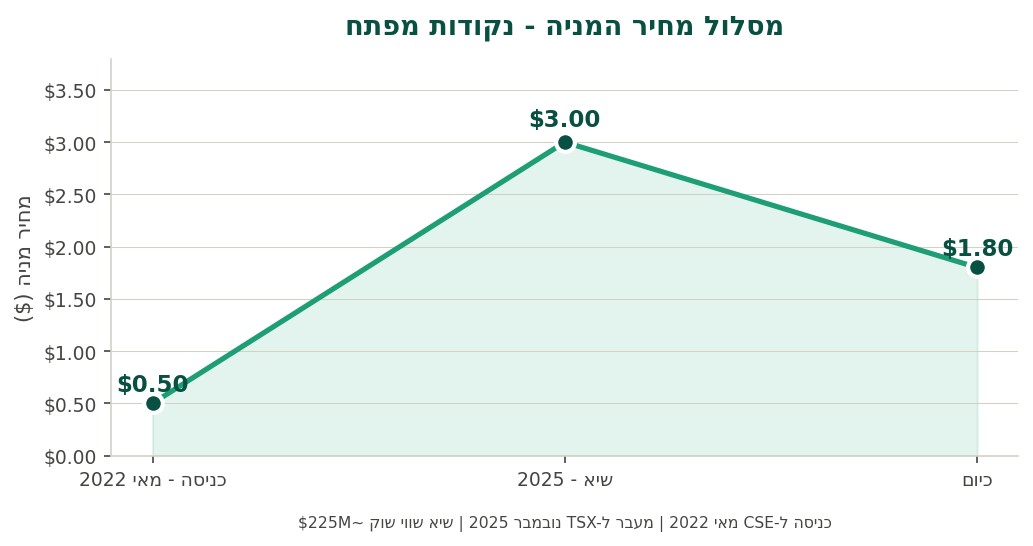
In November 2025, Beyond Oil completed its transition to the TSX—the main Toronto Stock Exchange, whose requirements are more stringent and whose investors are more institutional. The transition was not merely technical—it was a declaration: no longer early-stage, there is a working business here. The market responded accordingly. The stock price climbed to a peak of approximately $3—5 to 6 times the entry price. Market capitalization reached a peak of approximately $225 million and currently stabilizes around $150 million.
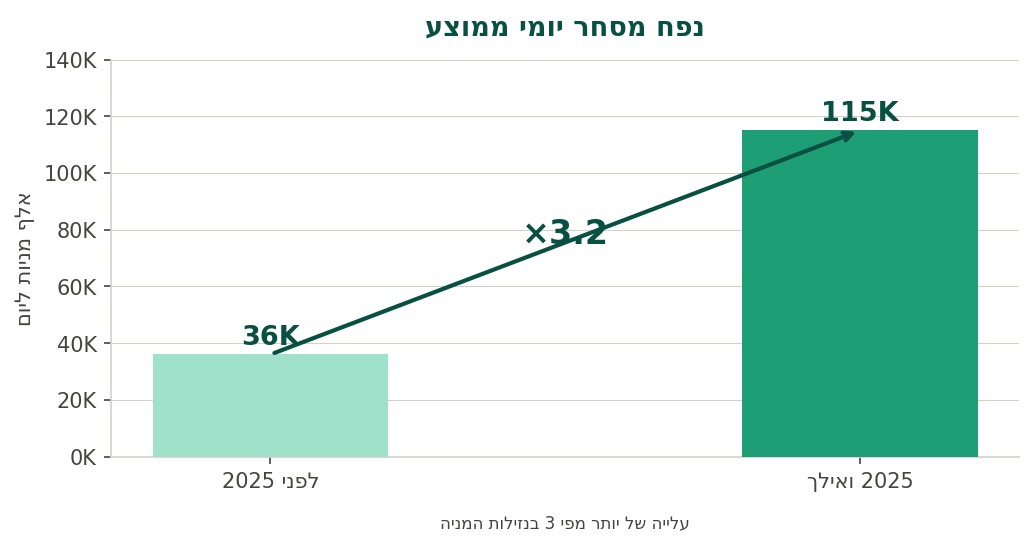
Daily trading volumes reflected this sharply: from an average of approximately 36,000 shares per day before 2025 to approximately 115,000 shares per day thereafter—an increase of more than threefold. Such growth in liquidity is not accidental; it indicates the entry of new investors and a real shift in how the market perceives the company.
Here it is worth stating plainly: a market capitalization of approximately $150 million on revenues of approximately $3.2 million in the first nine months of 2025 reflects a sales multiple of approximately 50. The market is not buying what exists—it is buying what is expected to be. This is entirely legitimate for early-stage growth companies, but it is a reminder that the company still reports an operating loss, because the investment in building a global market continues to cost money. The future is priced in—and the future still needs to materialize.
What Beyond Oil Teaches Us
What this story teaches extends far beyond a specific product. The pattern Beyond Oil followed—early entry to a secondary exchange, using capital to build operations, proving the business model, and then market repricing—repeats itself in many Israeli and international companies that have chosen the Canadian route. The difference between those that succeed and those that fail is often not the technology—but the understanding that the stock exchange is a tool, not a destination. Investors who identified the opportunity at the entry stage, when the risk was high but the potential greater, enjoyed returns of 5 to 6 times within approximately three years.
Exeeteems, a pioneer in listing Israeli technology companies on Canadian stock exchanges, is well familiar with this route and the parameters that distinguish between a company that will leverage it correctly and one that will not—companies relevant to this route are invited to contact us for an introductory conversation.
The stock exchange was not Beyond Oil’s destination. It was the bridge that built the path.
And sometimes that is precisely the difference between a company that enters the market—and a company that knows how to use it.
The information in this article is for analysis and educational purposes only and does not constitute investment advice. | Exiteam